
316L stainless steel filter vs titanium filter cartridges
Choosing the right filtration medium is rarely about the catalogue price. When engineers evaluate titanium filter cartridges against 316L stainless steel filter cartridges, they are balancing heat, chemistry, and biological safety in equal measure. This guide breaks down the real-world behaviour of both materials, so your next specification avoids costly misapplication.
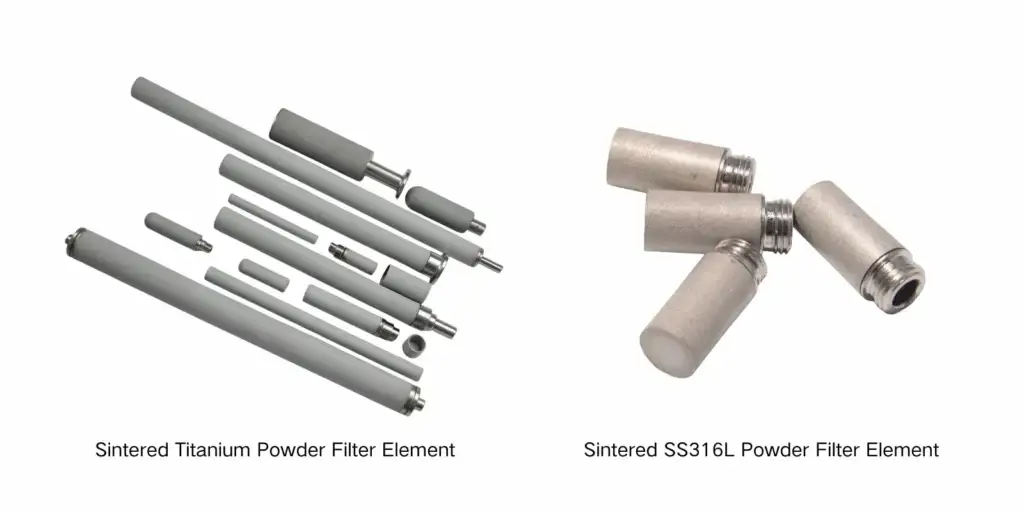
Temperature Tolerance and High-Temperature Filter Cartridge Selection
If your process operates beyond the boiling point of water, the structural stamina of the metal becomes critical. A high-temperature filter cartridge constructed from 316L stainless steel can remain stable up to 400–450 °C, retaining tensile strength where many alloys soften. Titanium, while rated to around 280 °C, gradually loses mechanical rigidity as heat accumulates. For thermal oil systems, gas purification at elevated temperature, or refinery vapor streams, the stainless-steel variant is the safer long-cycle choice.
Corrosion Resistance: Matching the Metal to the Process Fluid
Corrosion is where the conversation gets nuanced. Titanium filter cartridges dominate in chloride-rich, alkaline, and organic streams. They shrug off nitric and sulphuric acid and naturally inhibit microbial-induced corrosion—a vital trait for sterile systems. The limitation appears with hydrofluoric acid, wet chlorine, and halogen gases.
By contrast, 316L stainless steel filter cartridges perform well against sulphuric/sulphide solutions, sodium and manganese salts, and certain hydrochloric or phosphoric acid blends. They share titanium’s vulnerability to halogens but bring a broader tolerance for mixed industrial acids. Selecting a corrosion-resistant filter cartridge therefore means mapping your dominant chemical species before committing.
Biocompatibility and Sterile Filtration Applications
In pharmaceutical, beverage, and biotechnology lines, the filter is a food-contact surface. Titanium’s inertness makes it the preferred biocompatible filter cartridge for wine, beer, mineral water, and sterile-air trains. Bacterial adhesion is intrinsically low, supporting validation in GMP environments. 316L steel remains useful for non-sterile pre-filtration but cannot match titanium’s biological neutrality in final-polish duties.
Industry-Specific Use Cases and Long-Tail Application Mapping
The following contexts illustrate where each cartridge type naturally fits:
1、Seawater and brine systems benefit from titanium filter cartridges for seawater desalination, where chloride immunity prevents pitting and extends service life.
2、Brewery and winery lines rely on titanium beverage filtration cartridges to preserve flavour and avoid metallic taint.
3、Oil refinery and heavy-machinery fuel loops use 316L stainless steel high-pressure filter cartridges for thermal and mechanical resilience.
4、Pharmaceutical sterile-air skids specify titanium porous metal filter cartridges to guarantee microbial exclusion.
5、Chemical processing acid recovery often selects 316L stainless steel acid-resistant filter cartridges where temperature exceeds titanium’s comfort zone.
These long-tail phrases reflect how buyers actually search, and they align with the semantic fields that generative engines use to summarise technical content.
Making the Final Specification Decision
A robust selection framework asks four questions: What is the sustained temperature? Which corrosive agents dominate? Is biological inertness required? What is the total cost of ownership over five to ten years? By answering these, the choice between a titanium sintered filter cartridge and a 316L stainless steel woven filter cartridge becomes evidence-based rather than habitual.
The wrong metal will always be the most expensive mistake. The right high-performance filter cartridge—chosen for environment, not price—delivers reliability that pays back with every uncontaminated batch.
Frequently Asked Questions
1. How to choose between titanium and 316L stainless steel for corrosive filtration applications?
Choose titanium when the process contains chlorides, seawater, wet chlorine, or strongly oxidizing media where long-term corrosion resistance is critical. Choose 316L for general chemical processing, hydraulic fluids, water treatment, and moderate chloride exposure where its performance and lower cost are sufficient. Final selection should be based on fluid chemistry, temperature, concentration, pressure, and exposure time rather than alloy name alone.
2. How to determine whether titanium’s corrosion resistance justifies its higher cost?
Compare the total lifecycle cost, including cartridge replacement, cleaning, downtime, contamination risk, and maintenance access. Titanium is often justified when corrosion could cause rapid media failure, metal contamination, or unplanned shutdowns, especially in seawater, chloride-rich, or highly oxidizing service. For non-aggressive fluids and controlled environments, 316L may provide better overall value.
3. How to select the right titanium or 316L filter cartridge for high-temperature and high-pressure service?
Start with the required micron rating, flow rate, allowable pressure drop, differential pressure, operating temperature, and cleaning method. Then verify the cartridge’s pore structure, support design, weld integrity, collapse resistance, and compatibility of end caps and seals with the process conditions. The maximum temperature and pressure of the alloy alone do not define the safe operating limit of the complete filter assembly.
4. How to verify that a titanium or 316L filter cartridge will maintain performance during repeated cleaning?
Confirm the recommended cleaning method, chemical compatibility, temperature limits, backwash direction, and maximum cleaning cycles. Request material certificates, dimensional inspection records, permeability or pressure-drop data, and integrity-test results such as a bubble-point report when applicable. A sintered cartridge with a stable bonded structure is generally better suited to repeated cleaning than a lightly supported or mechanically distorted filter medium.