
Metal Filter Cartridge Manufacturer in China
Custom metal filter elements and brand-compatible replacements for industrial buyers worldwide. Based in Anping County, Hebei, we supply stainless steel filter cartridges from 1 to 200 μm in 316L, 304 and titanium, quoted from drawings, samples or OEM part numbers.
Who We Are
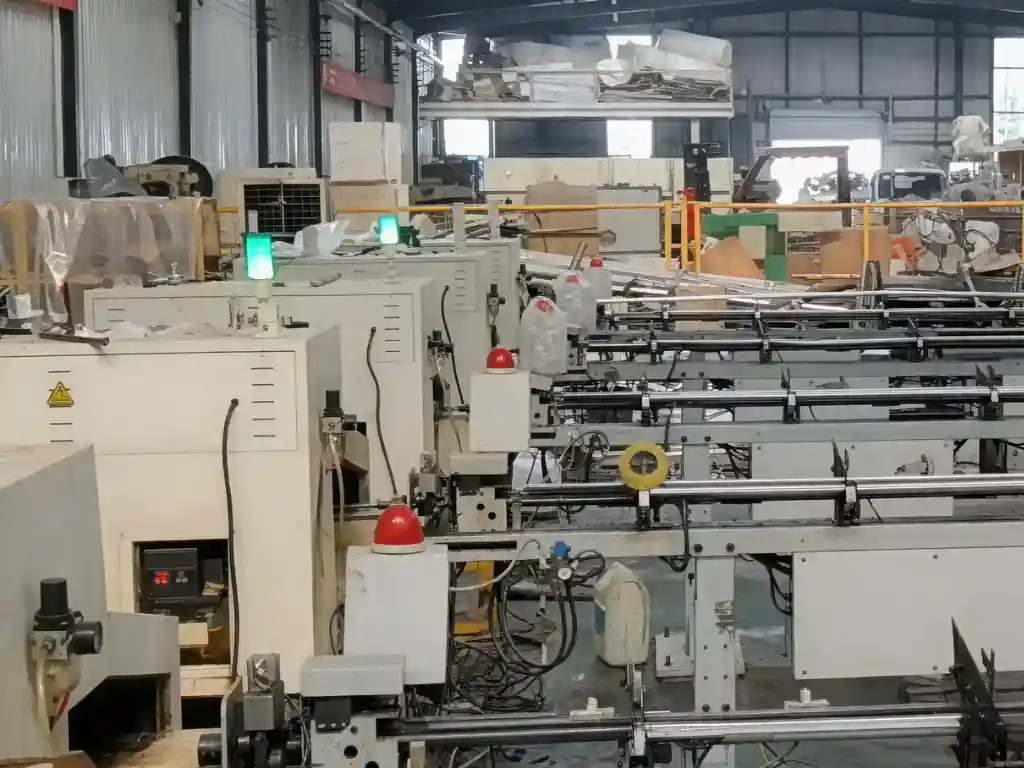
Tanqi Industry provides technical solutions based in Anping, China’s wire mesh hub, supported by local technical resources to deliver specification-verified stainless filter cartridge equivalents to OEM standards.
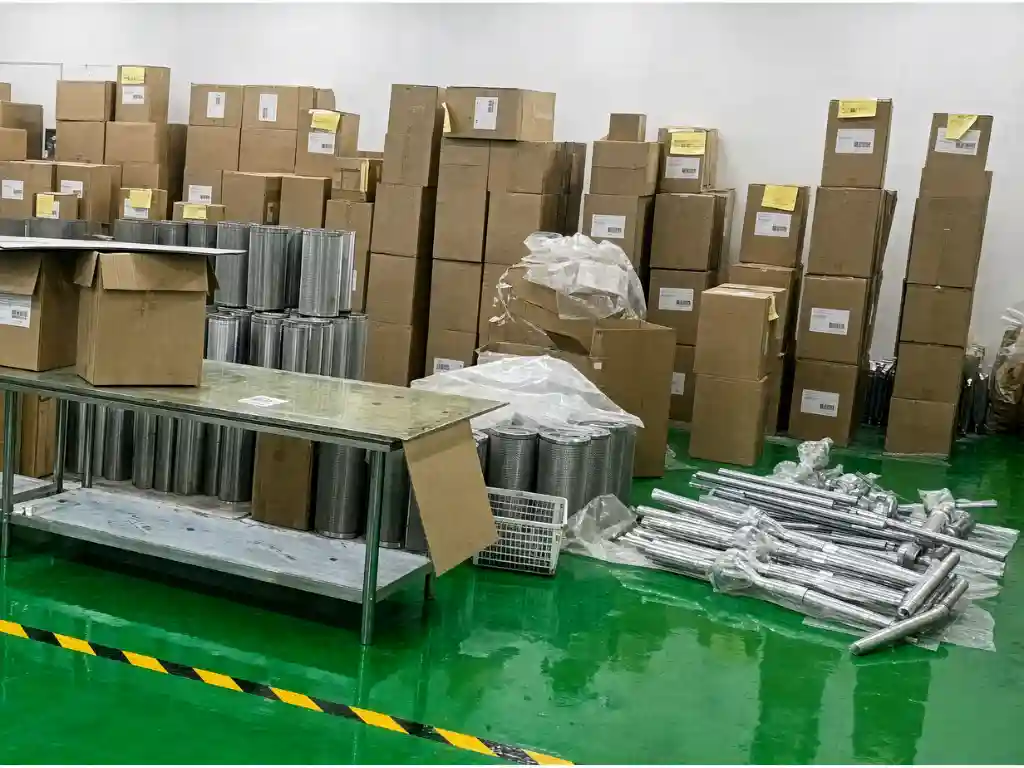
Every TQ part number is released against the original drawing with dimensional checks completed before delivery.
How We Work — And Why It Matters
Application-Driven Selection
We don’t push catalog options. Instead, we ask: What’s your medium? Temperature? Pressure? Flow? Based on your answers, we recommend the right media — stainless steel, titanium, nickel — and structure. No guesswork. No surprises.
Specification-Verified Solutions
Technical Coordination in Anping
Our Product Range
OEM Replacement Filters
HYDAC · Pall · Parker · CJC · Donaldson etc. compatible replacements
For part-number research, an industrial product cross reference tool may help identify the original specification before requesting a quotation.
Cross-referenced by part number or drawing. For hydraulic replacement research, buyers may also consult a hydraulic filter cross-reference database or review guidance on how to cross-reference a filter element. We coordinate suitable alternatives based on the actual specification.
Sintered Wire Mesh Filters
Multi-layer 316L · 1–200 µm
Rigid diffusion-bonded structure, fully cleanable and deformation-resistant. For chemical and hydraulic systems worldwide.
Sintered Metal Fiber Felt Filters
1–200 µm · ≥80% porosity
3D stainless steel fiber network with high dirt-holding capacity. Trusted in European pharma and North American polymer lines.
Sintered Powder Metal Filters
0.1–100 µm · up to 550°C
Uniform porous structure from stainless steel, titanium and nickel powders. Ideal for polymer melt and high-temperature gas filtration.
Wedge Wire Screens
Non-clogging V-slot · 20–1000 µm
All-welded 304/316L and duplex construction. Widely used in water intake and desalination across Asia-Pacific.
Stainless Steel Pleated Filter
Reusable · high surface area
Argon-welded 304L/316L mesh or felt media. Suited for food, beverage and electronics-grade applications.
Our Quality Control Process
1
Inquiry
Review media, temp, pressure
2
Matching
Matching the right filter cartridge
3
Sampling
Verify dimensions & performance
4
Production
5
Inspection
6
Delivery
Export docs & logistics
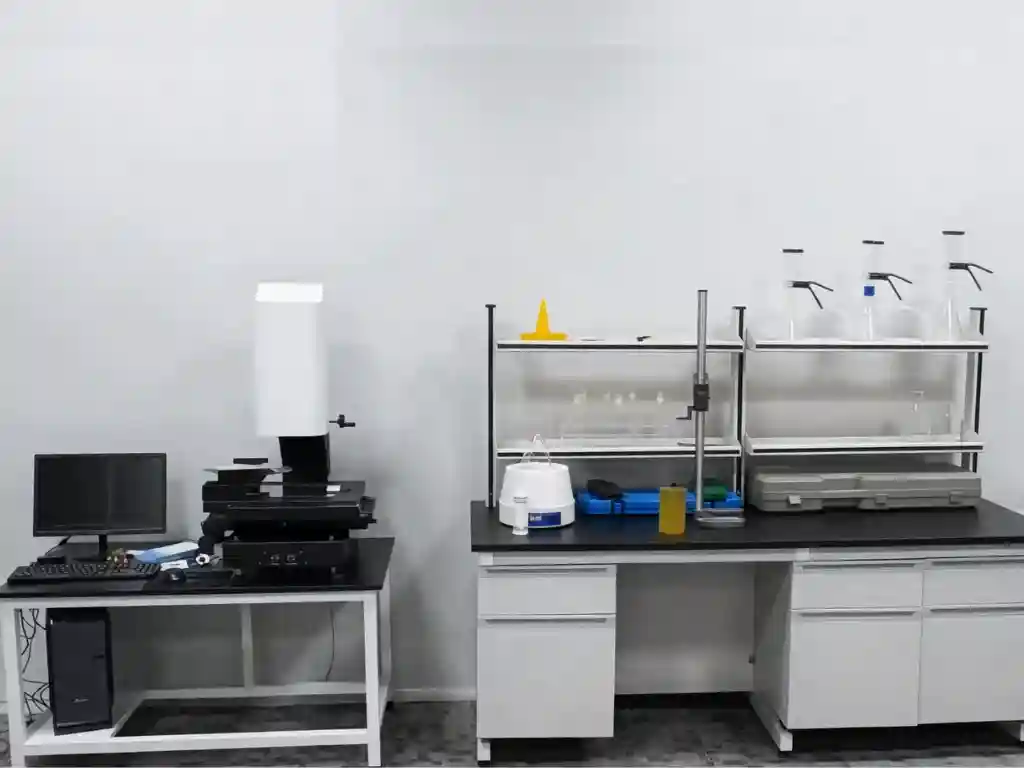
Testing & Inspection Capabilities


Documents and Certificates Supplied With Your Order
Buyers rarely need a certificate for its own sake. What they need is evidence that the element in the crate is the element that was ordered, made from the material that was specified. That evidence is assembled per order, and the list is agreed with the buyer before the order is released rather than settled after the goods are packed.
| Document | Issued for | What it shows |
|---|---|---|
| Material certificate (EN 10204 3.1) | Stainless steel and alloy elements, on request | Alloy grade, heat number and chemical composition, traced back to the mill |
| Dimensional inspection report | Custom elements and OEM equivalents | Measured values against the approved drawing, with the critical callouts marked |
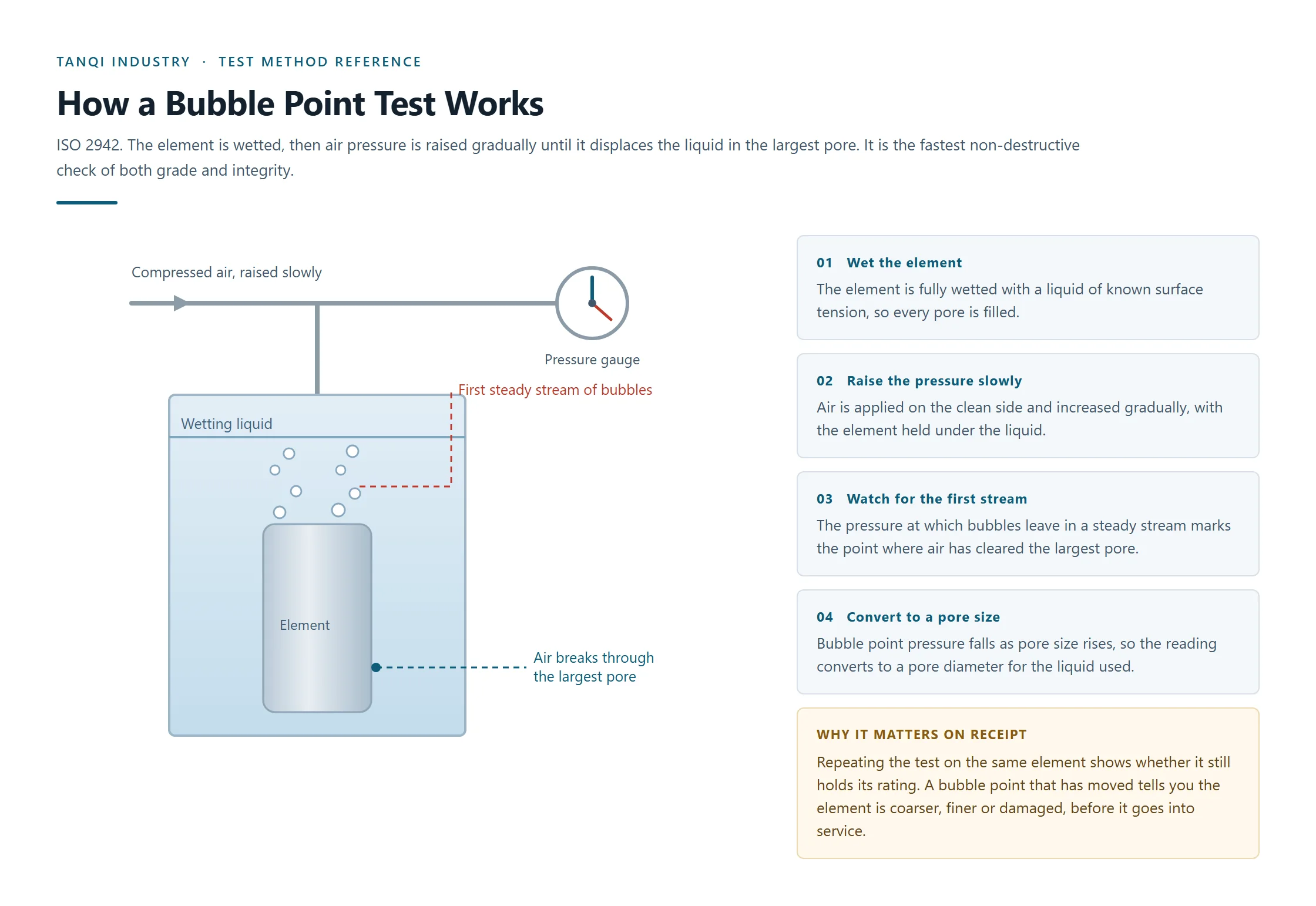
| Bubble point test report | Sintered and wire mesh elements | The measured bubble point against the band for the rating ordered, so the grade can be verified on receipt |
| Third-party inspection report | On request, through the buyer's nominated inspection agency | Pre-shipment inspection carried out to the buyer's instruction before the goods leave |
| Material declaration | On request | Statement covering the alloy, surface finish and sealing compound supplied |
| Packing list and certificate of origin | Every export shipment | Itemised contents with HS code, issued together with the shipping documents |
Two details matter more than the list itself. Where the order specifies it, the inspection record is written against the drawing the buyer approved rather than a generic specification, so a dimensional discrepancy shows up before shipment instead of on arrival. And if a particular document set is needed for customs, tendering or a client audit, it is far easier to agree it at the enquiry stage, because adding a third-party inspection or a named declaration after production can hold up a shipment that is otherwise ready.
Where a buyer's own auditor or agent needs to attend before release, say so with the enquiry and the schedule can be built around it.
The Standards Behind the Elements, and How to Check Them
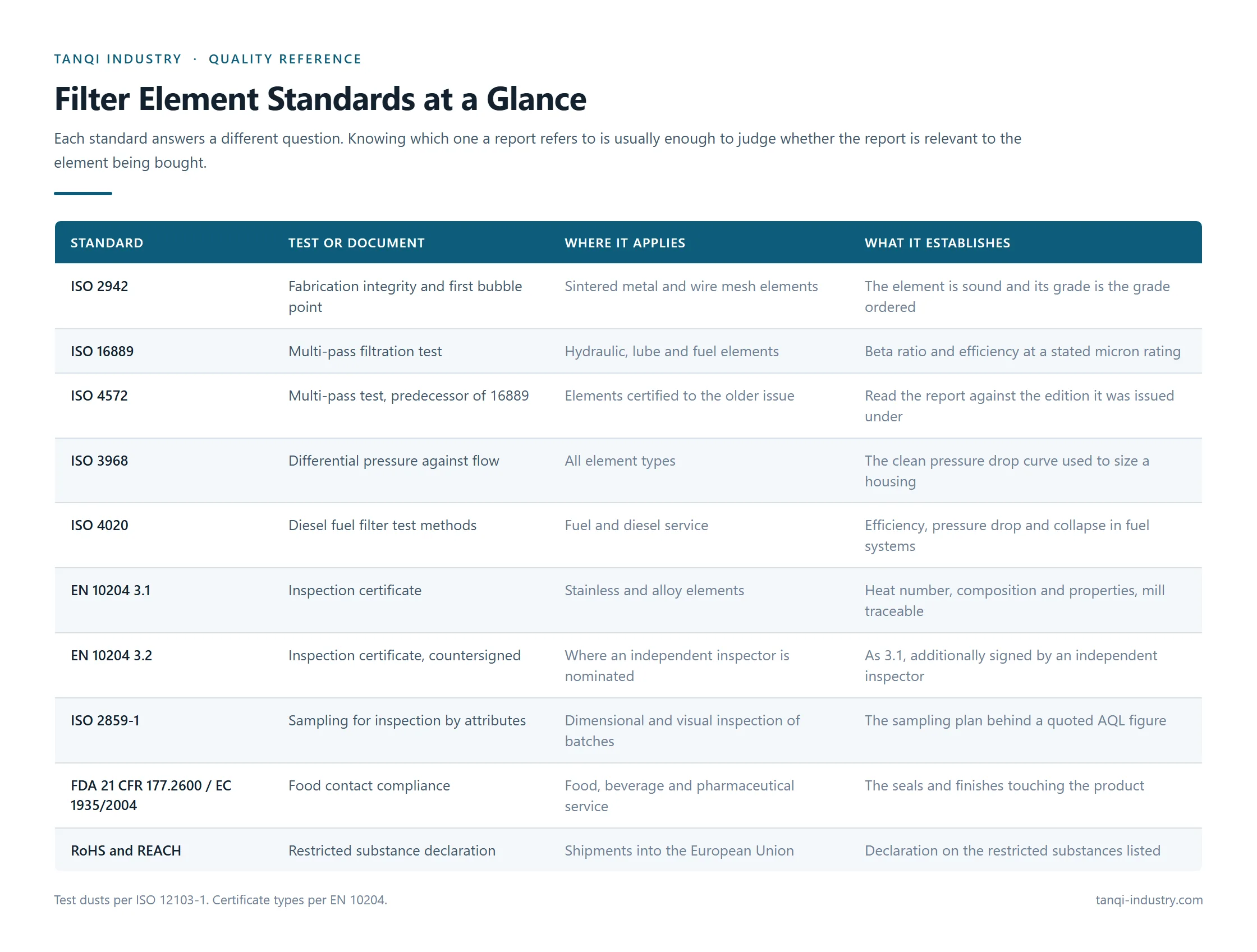
A certificate is only useful if it can be checked. The methods below are the ones an inspection report can be raised against, and each one answers a different question. Knowing which standard a report refers to is usually enough to tell whether that report is relevant to the element being bought.
| Standard | Test or document | Where it applies | What it establishes |
|---|---|---|---|
| ISO 2942 | Fabrication integrity and first bubble point | Sintered metal and wire mesh elements | Non-destructive check that the element is sound and that its grade is the grade ordered |
| ISO 16889 (formerly ISO 4572) | Multi-pass filtration test | Hydraulic, lube and fuel elements | Beta ratio and filtration efficiency at a stated micron rating, measured with ISO 12103-1 test dust. A multi-pass rig is required; where a multi-pass figure is needed it is arranged through a third-party laboratory and noted as such on the report |
| ISO 3968 | Differential pressure against flow | All element types | The clean pressure drop curve used to size a housing and set a change-out point |
| ISO 4020 | Diesel fuel filter test methods | Fuel and diesel service | Efficiency, pressure drop and collapse behaviour in fuel systems |
| EN 10204 3.1 | Inspection certificate | Stainless and alloy elements | Heat number, chemical composition and mechanical properties, traceable to the mill |
| EN 10204 3.2 | Inspection certificate, countersigned | Where an independent inspector is nominated | The same evidence as 3.1, additionally signed by an inspector independent of the producer |
| ISO 2859-1 | Sampling for inspection by attributes | Dimensional and visual inspection of batches | The sampling plan behind an AQL figure quoted in an inspection report |
| FDA 21 CFR 177.2600 and EC 1935/2004 | Food contact compliance | Food, beverage and pharmaceutical service | Covers the sealing compounds and finishes that come into contact with the product. Compliance follows the compound actually fitted, so name the requirement at the enquiry stage |
| RoHS and REACH | Restricted substance declaration | Shipments into the European Union | Declaration on the restricted substances listed in the two directives |
Checking a certificate takes a few minutes and is worth doing before the goods are accepted rather than after. Four things are worth confirming. The certificate number should be findable on the register kept by the issuing body. For a quality management certificate issued against ISO 9001 that means the accreditation body behind the issuer rather than a reseller, and the accreditation mark on the copy should correspond to a body that can be looked up. The scope should name the product actually supplied, because a certificate covering machining does not cover a sintered element. The legal entity named on the certificate should be the entity that is invoicing you, since a trading name can sit in front of a certificate that belongs to somebody else. And the edition year of the standard should match the edition the certificate was issued against, because an older issue may not test what you expect it to test.
For material certificates the heat number is the thread that ties the paperwork to the metal. The number printed on the certificate should appear on the element or on its label, and it should be the same number carried on the report that accompanied the melt. Where a document set is needed for a client audit or for customs, name the standard and the edition in the enquiry, because that is the point at which the inspection route can still be chosen rather than reported after the fact.
Frequently Asked Questions
What are your main products?
We specialize in industrial filtration elements and porous metal components. Our core product range includes:
- Sintered Wire Mesh Filters & Laminates
- Sintered Metal Fiber Felt Filters
- Sintered Metal Powder Filters (Porous Plates, Tubes, Spargers)
- Wedge Wire Screen Filters (Johnson Screens)
- Wire Mesh Filter Elements
- OEM Replacement Filters for major hydraulic, gas, Coalescing-Separator and lubrication brands
These products are widely applied in polymer processing, water treatment, petrochemicals, food & beverage, and power generation sectors.
For OEM-compatible replacements, see our OEM replacement filters range.
What is your samples policy?
Samples are available on a case-by-case basis. For low-value, standard filter elements, we can generally provide samples free of charge; however, all associated shipping costs shall be borne by the customer. For higher-value or customized products, sample fees may apply; these charges will be fully credited against your first formal production order. All sample requests are subject to technical review and prior written confirmation with our sales team.
Do you accept custom orders?
Yes, customization is our core strength. We accept production based on:
- Technical Drawings: DWG, DXF, STEP, or PDF formats.
- Physical Samples: Reverse engineering from your existing parts.
- Detailed Specifications: Including dimensions, micron rating, material grade (e.g., SS316L, Hastelloy), and connection type.
Whether you require a non-standard filter disc, a special alloy wedge wire screen, or a complex sintered assembly, our engineering team evaluates feasibility and provides tailored solutions to match your operational requirements.
What is your return and exchange policy?
We accept return/replacement claims only for confirmed manufacturing defects or shipment errors, reported within 15 working days of delivery with supporting photos and documents. Used filter elements, incorrectly ordered models, or issues caused by improper installation/operating conditions are non-returnable. Upon verification, we typically provide replacement units or apply credit to the next order rather than cash refund. Return of any product must be unused, in original packaging, and pre-approved in writing. Shipping charges follow the party responsible for the fault.
What are your core advantages?
We operate from Anping County, Hebei—China’s leading wire mesh and filtration manufacturing hub. This strategic location provides:
- Material Access: Direct sourcing of stainless steel wire, alloy powders, and fiber media ensures consistency and cost control.
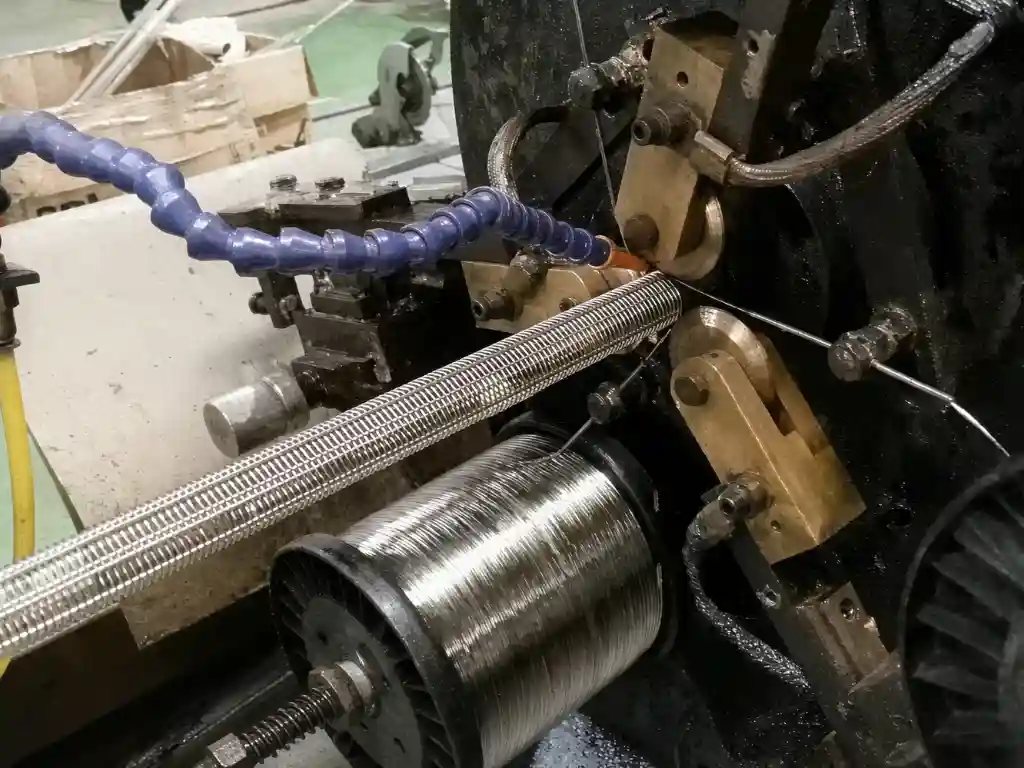
- Process Control: Integrated capabilities from raw material inspection to final assembly.
- Flexibility: Ability to handle both small-batch prototyping and large-scale production runs.
- Technical Support: Engineering support for material selection, tolerance analysis, and application matching.
We focus on delivering practical, cost-effective filtration solutions with transparent communication and reliable delivery schedules.
Need the Right Filter for Your Project? Let’s Talk.
Share your application, dimensions, and quantity — we’ll source suitable options from Anping and return with clear proposals and lead times.
