Stainless Steel Alloy Filter Comparison: 304 vs 316 vs 310 vs 316L vs 317L
When engineers search for stainless steel filter cartridge or buy 316L sintered filter element 5 micron, the real question is not “which stainless is best” — it is “which alloy survives my fluid, temperature, and cleaning cycle without failing in six months.” This guide compares 304, 304L, 316, 316L, 310, and 317L across real filtration duty.
Chemical Composition and Corrosion Margin
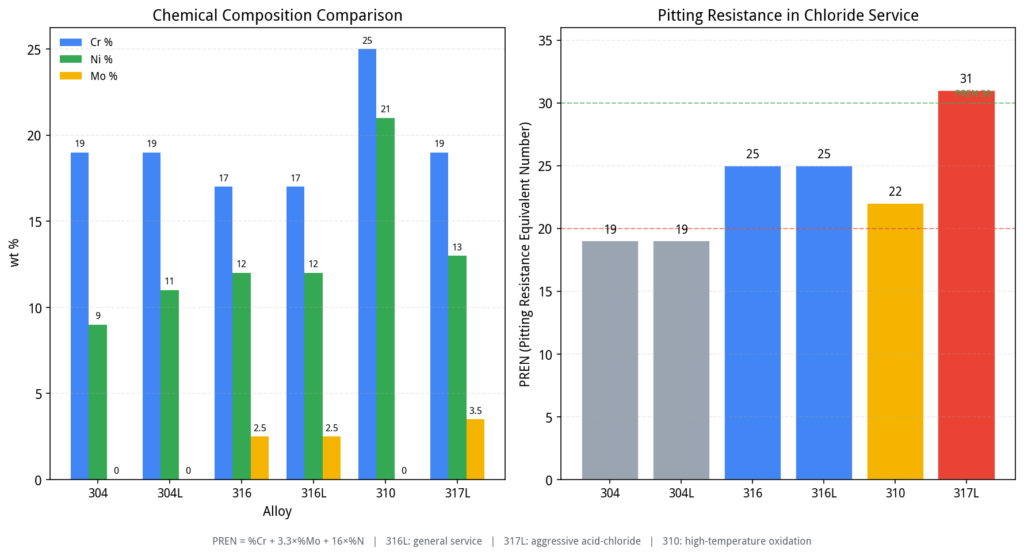
| Alloy | Cr % | Ni % | Mo % | Pitting Resistance (PREN) | Best For |
|---|---|---|---|---|---|
| 304 | 18–20 | 8–10.5 | — | ~19 | Water, air, mild solvents, food-grade CIP |
| 304L | 18–20 | 8–12 | — | ~19 | Same as 304, but welded structures needing low carbon |
| 316 | 16–18 | 10–14 | 2–3 | ~25 | Sea water, dilute acid, chloride up to ~200 ppm |
| 316L | 16–18 | 10–14 | 2–3 | ~25 | Pharma, food, welded cartridges, acid + chloride |
| 310 | 24–26 | 19–22 | — | ~22 | High temp up to 1100°C, furnace gas, oxidation |
| 317L | 18–20 | 11–15 | 3–4 | ~30 | Sulfuric acid, phosphoric acid, aggressive chloride |
pitting resistance equivalent number (PREN):PREN = %Cr + 3.3 × %Mo + 16 × %N
What Changes When You Pick a Different Alloy
The alloy does not change the micron rating. A 5 micron 304 cartridge and a 5 micron 316L cartridge both filter the same particle size. The alloy changes how long the cartridge lives before corrosion forces a change-out.
- 304 / 304L: cheapest, fine for clean water and non-corrosive air. Fails fast in chloride above 50 ppm or any acid.
- 316: the general-purpose workhorse. Handles most process water, mild acid, and moderate chloride.
- 316L: same as 316 but low carbon. Required when the filter cartridge is welded, or when intergranular corrosion is a risk after repeated CIP cycles.
- 310: chosen for heat, not chemical resistance. If your stream is above 600°C, 316 will not survive but 310 will.
- 317L: the heavy hitter for acid-chloride combinations. More expensive than 316L but outlasts it in sulfuric and phosphoric acid service.
Common Buying Mistakes
The two mistakes we see most: (1) specifying 316 when 317L is needed, then replacing cartridges every three months; (2) specifying 317L when 304 would do, wasting budget on alloy that never pays back. Match the alloy to the worst day in the process, not the average day.
How to Write a Filtration-Specification RFQ That Actually Gets Answered
Vague requests like buy stainless steel filter cartridge, 10 inch, 5 micron get generic answers. A good RFQ includes:
- Process fluid: name, concentration, temperature, pH
- Solids to be removed: particle size distribution (PSD)
- Operating pressure and backpressure limits
- Required micron rating and filtration mode: surface or depth
- Alloy preference: 304, 316, 316L, 310, 317L — with reason
- End connection: 222, 226, DOE, flat, threaded, welded
- Cleaning method: CIP, automated backwash, acid wash
- Certification needs: mill cert, ASTM, surface finish, leak test
- Quantity, lead time, and after-sales support
Frequently Asked Questions
Is 304 stainless steel good enough for filter cartridges?
For clean water, air, and food-grade CIP below 50 ppm chloride, yes. For any acid or chloride above 50 ppm, step up to 316L.
What is the difference between 316 and 316L for filtration?
316L has lower carbon (0.03% max vs 0.08% max). This prevents carbide precipitation after welding or repeated heat cycles, making 316L the right choice for welded filter cartridges and pharma/food service.
When should I specify 310 instead of 316L?
When the process temperature exceeds 600°C. 310 has high chromium and nickel for oxidation resistance. For chemical corrosion at lower temperatures, 316L is the better choice.
Is 317L worth the extra cost over 316L?
In sulfuric acid, phosphoric acid, or chloride above 2000 ppm, yes — 317L’s higher molybdenum gives a significantly longer service life. In mild service, 316L is more economical.
Can I use 304L instead of 304?
Yes, and it costs little more. If the cartridge is welded or sees repeated CIP, 304L avoids intergranular corrosion. For non-welded, non-heated service, 304 is fine.
Which alloy should I choose for sea water filtration?
316L handles brackish water and low chloride. For full sea water or sour gas, consider 317L or a nickel alloy. 304 will pit within weeks.
Do you supply custom micron ratings and lengths?
Yes. Common ratings are 0.5, 1, 2, 5, 10, 20, 50 micron. Lengths from 5 to 40 inch. End connections include 222, 226, DOE, flange, and welded. Send your RFQ and we return a material recommendation.
Need the Right Alloy, Not the Expensive One?
Send us your process fluid, temperature, chloride level, micron rating, and cleaning method. We return a material recommendation + RFQ-ready specification sheet within one business day.