
Polymer melt is one of the few duties where the operating window eliminates most filter media before the micron rating is even discussed. A polyester melt line runs at 280 to 400 C, the melt pump applies 50 to 500 bar, and viscosity is measured in hundreds of pascal-seconds. Paper and glass fibre cannot enter that window at all, and a pleated cartridge deforms under the pressure pulse of a screen changer. Sintered metal fiber felt occupies the space that is left. This guide covers the six numbers that decide whether a felt element completes a campaign or blinds in the first shift.
A note on naming: the material is sold as metal fibre felt, sintered metal fiber felt and sintered stainless steel fibre filter, and the three names describe the same product. What varies between suppliers is the fibre diameter, the porosity after sintering, and whether the felt is supplied as a single layer or bonded to a support mesh.
Why melt filtration punishes surface media
The contaminant in a melt line is not a clean distribution of particles. It is a mixture of gel, unmelted resin, carbonised residue and deliberately added inorganic filler, and the finer fractions sit in the 1 to 20 um range that the finished film cannot tolerate. A surface medium captures that load as a cake on the upstream face, and the cake is not the main problem: the face itself blinds, because gel compresses into the openings and the differential pressure climbs faster than the dirt load would suggest.
The consequence is a rule that has nothing to do with ratings. In melt service the useful measure is not how fine the medium filters, but how long it does so before the pressure reaches the limit set by the melt pump or the breaker plate. That is a function of pore volume, not pore size, and it is why a depth medium wins.
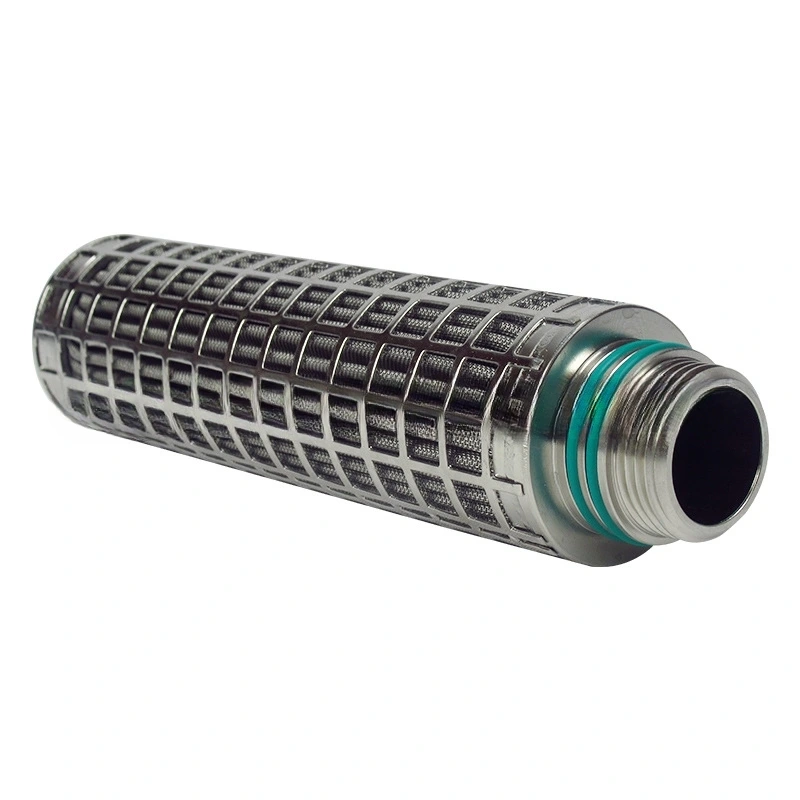
316L fibre sintered to a support mesh. Capacity comes from pore volume rather than pore size, which is why melt duty is specified by campaign length and not by micron rating alone.
What the felt structure provides
Sintered metal fiber felt is made from drawn stainless steel fibre, laid into a mat and sintered until the fibres bond at every contact point. The result is a three-dimensional pore network with porosity of 75 to 85 per cent, roughly double that of a woven mesh of the same nominal rating. Dirt is captured through the thickness of the wall rather than on the face, so on-line time is longer and the pressure rise per unit of dirt is flatter.
Two structural properties matter for melt duty specifically. First, because every fibre crossing is bonded, the pore geometry does not shift under repeated back-flushing, so the rating measured on a sample is the rating delivered after the two-thousandth reverse pulse. Second, the material is ductile enough to be pleated and welded into a cartridge without the fibre shedding that a brittle medium would produce.
Grade table: rating, bubble point and permeability
The table below is the standard production range and matches the values published on the product page. Bubble point is the acceptance test quoted on the inspection report, because it is the only measurement that confirms the grade that actually arrived.
| Nominal rating (um) | Bubble point (Pa) | Air permeability (L/min.dm2) | Porosity (%) | Thickness (mm) |
|---|---|---|---|---|
| 5 | 6800 | 47 | 75 | 0.30 |
| 7 | 5200 | 63 | 76 | 0.30 |
| 10 | 3700 | 105 | 75 | 0.37 |
| 15 | 2450 | 205 | 79 | 0.40 |
| 20 | 1900 | 280 | 80 | 0.48 |
| 25 | 1550 | 355 | 80 | 0.62 |
| 30 | 1200 | 520 | 80 | 0.63 |
| 40 | 950 | 670 | 78 | 0.68 |
| 60 | 630 | 1300 | 85 | 0.62 |
Read the table in two directions. Bubble point halves each time the rating doubles, so a bubble point test on a used or delivered element tells you immediately whether it is finer or coarser than ordered. Air permeability moves in the opposite direction: the 60 um grade passes about twenty-eight times the air of the 5 um grade, which is the pressure drop difference you will see expressed as a melt pressure reading at the head of the line.
Rule 1: set the rating from the defect, not the catalogue
The rating follows the smallest defect the downstream process rejects. Optical film and lithium battery separator duty generally runs 3 to 5 um with an electropolished 316L felt, because the surface finish and the rating are both part of the optical specification. Packaging film and fibre grade runs 5 to 10 um. Where the process simply protects a gear pump or a spin pack, a coarser grade with a larger dirt capacity will give more on-line time for the same pump limit.
Rule 2: multi-layer, not single-layer, where back-flushing is continuous
A continuous back-flush screen changer reverses the flow thousands of times per campaign. A single-layer felt drifts in rating under that cycling because the unsupported fibre mat shifts slightly at each pulse. Multi-layer construction with a sintered mesh support on both faces holds the fibre layer in position and keeps the collapse strength above the reverse differential. The support mesh is not there for filtration and its rating is not the rating of the element.
Rule 3: match the alloy to the polymer, not to the temperature alone
316L covers the great majority of polymer duty. Inconel felt is specified where engineering polymers such as PPS run above 300 C continuously, and where the melt is aggressively corrosive against stainless steel. Two points are worth stating plainly: the useful temperature of any alloy is lower in an oxidising atmosphere than in a reducing one, and prolonged operation at the top of an alloy range shortens service life even when the element is not failing outright.
Rule 4: quote the collapse rating against the reverse differential
Most felt element failures in melt service begin on the reverse stroke. The breaker plate and the melt pump can apply a reversed differential in a fraction of a second that is higher than the steady forward pressure, and that peak is what the element has to survive without deforming. Give the supplier the forward differential, the reverse differential, the rate at which the reverse is applied and the temperature at that moment.
Rule 5: decide the regeneration sequence before the first order
A felt element is reused rather than consumed, so the cleaning route is part of the specification and not an afterthought. Chemical soak, pyrolytic burn-off and ultrasonic cleaning all work on sintered felt, but the sequence has to suit both the alloy and the contaminant. Carbonised residue that is not fully removed stays inside the pore structure, raises the bubble point and shortens the next campaign. Batch service typically returns three to five cycles with periodic regeneration; where continuous back-flush is available, users report multi-year element life.
Rule 6: verify with a bubble point after every clean
The bubble point band for the grade is the acceptance criterion, and it is worth asking for the value on the inspection report that ships with the order. Compare the clean differential pressure with the figure recorded when the element was new. An element inside its bubble point band, with a clean differential pressure close to the original figure, has genuinely returned to service. An element that is inside the band but reading a high clean differential pressure has not been cleaned through, and the next campaign will be shorter than the last.
Metal fiber felt against sintered mesh and powder
| Medium | Structure | Where it fits |
|---|---|---|
| Sintered metal fiber felt | Depth filtration, 75 to 85 per cent porosity | High viscosity and high temperature duty, large dirt load, fine rating without a steep pressure drop |
| Five-layer sintered mesh | Surface filtration, rigid diffusion-bonded laminate | Reusable element where the reverse differential is high and the rating must not drift |
| Sintered metal powder | Isotropic porous solid | Corrosive media, the finest pore sizes, gas distribution and sparging |
The three are not ranked by quality. A melt line wants felt for pore volume, a hydraulic loop with stored-gas backwash wants the laminate for collapse strength, and a chloride or caustic duty wants powder or a different alloy. The specification follows the duty, and a supplier who quotes all three without asking about the medium has not understood the question.
Elements are tested against the bubble point method described in ISO 2942, and material certificates follow EN 10204 3.1 where a certificate of the actual cast is required.
How to enquire
- Rating. Nominal or absolute, and the bubble point band you will accept.
- Form. Disc, tube, pleated cartridge or panel, with overall dimensions or a drawing.
- Medium. Polymer grade, operating and peak temperature, and whether the atmosphere is oxidising or reducing.
- Pressure. Forward differential, reverse differential and how fast the reverse is applied.
- Cleaning plan. Method and frequency, which decides the layer count and the support mesh.
Send those five items with a sketch and the layer construction, alloy and support mesh can be confirmed before any tooling or production commitment, with the drawing returned for approval.
Related pages
- Sintered stainless steel fiber felt filters, full grade and ordering table
- Five-layer sintered wire mesh, the surface-filtration alternative
- Sintered stainless steel powder filters, for the finest pore sizes
- Filter element applications by industry and medium